
QUALITY CONTROL
Quality is about more than just
purity.
At GenHelix Optima, we believe rigorous quality control goes far beyond a single purity result.
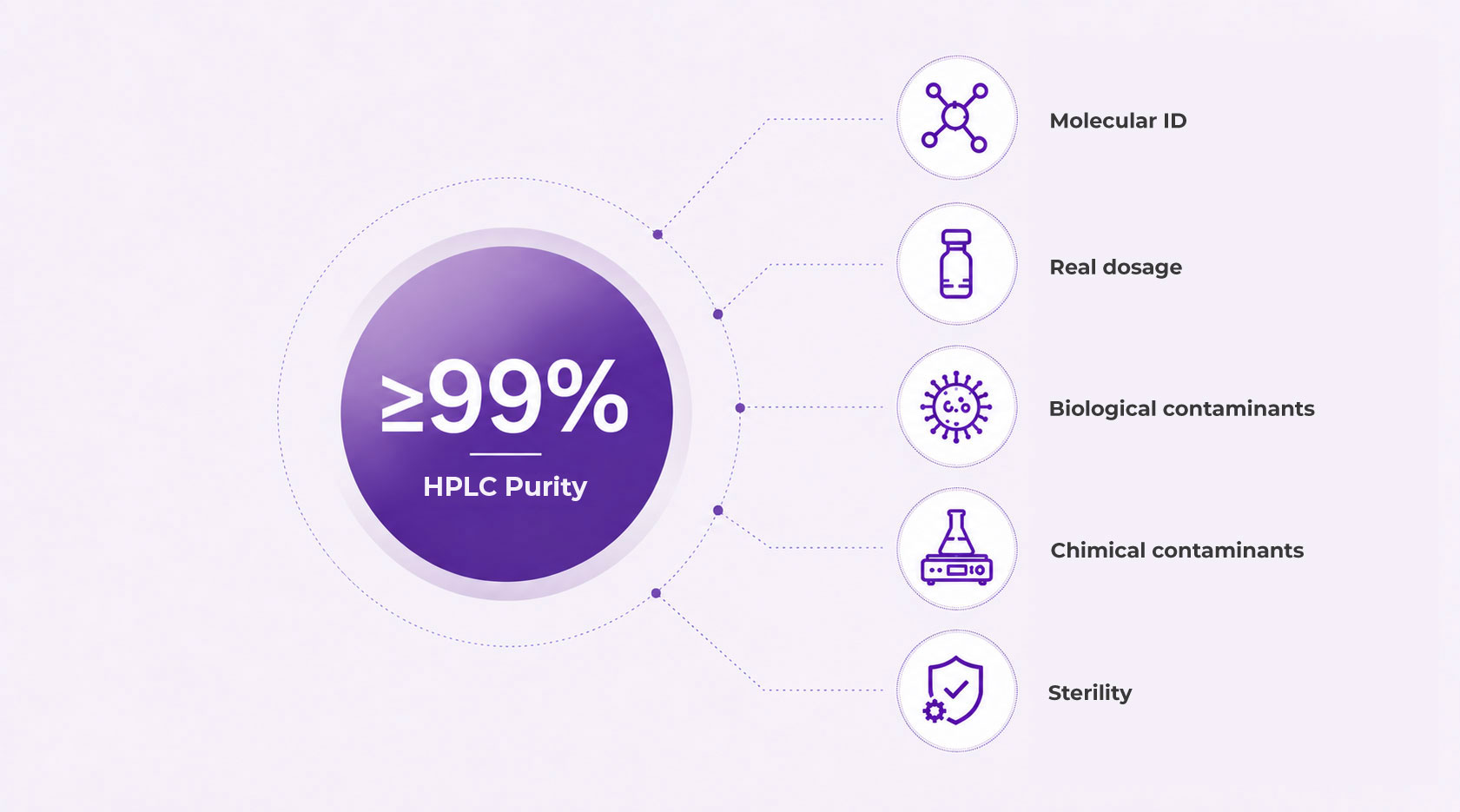
A peptide may have a purity of over 99% while still containing endotoxins, heavy metal contaminants, bacteria, or an actual peptide content that differs from the labeled amount.
That is why every batch undergoes a comprehensive testing protocol to verify the molecule's identity, purity, actual peptide content, and the absence of critical contaminants.
Because true quality is never defined by a single number.
Purity is essential...
but it tells only part of the story.
Many suppliers focus primarily on the HPLC purity of their products.
While this information is essential, it is not sufficient on its own to assess the overall quality of a peptide.
A high purity value provides no information about the molecule's exact identity, its actual peptide content, or the possible presence of biological or chemical contaminants.
At GenHelix Optima, we have chosen to go far beyond this single metric to obtain a comprehensive assessment of every batch before it is made available.
EVERY STEP MATTERS
Our evaluation protocol

HPLC
Why measure peptide purity?
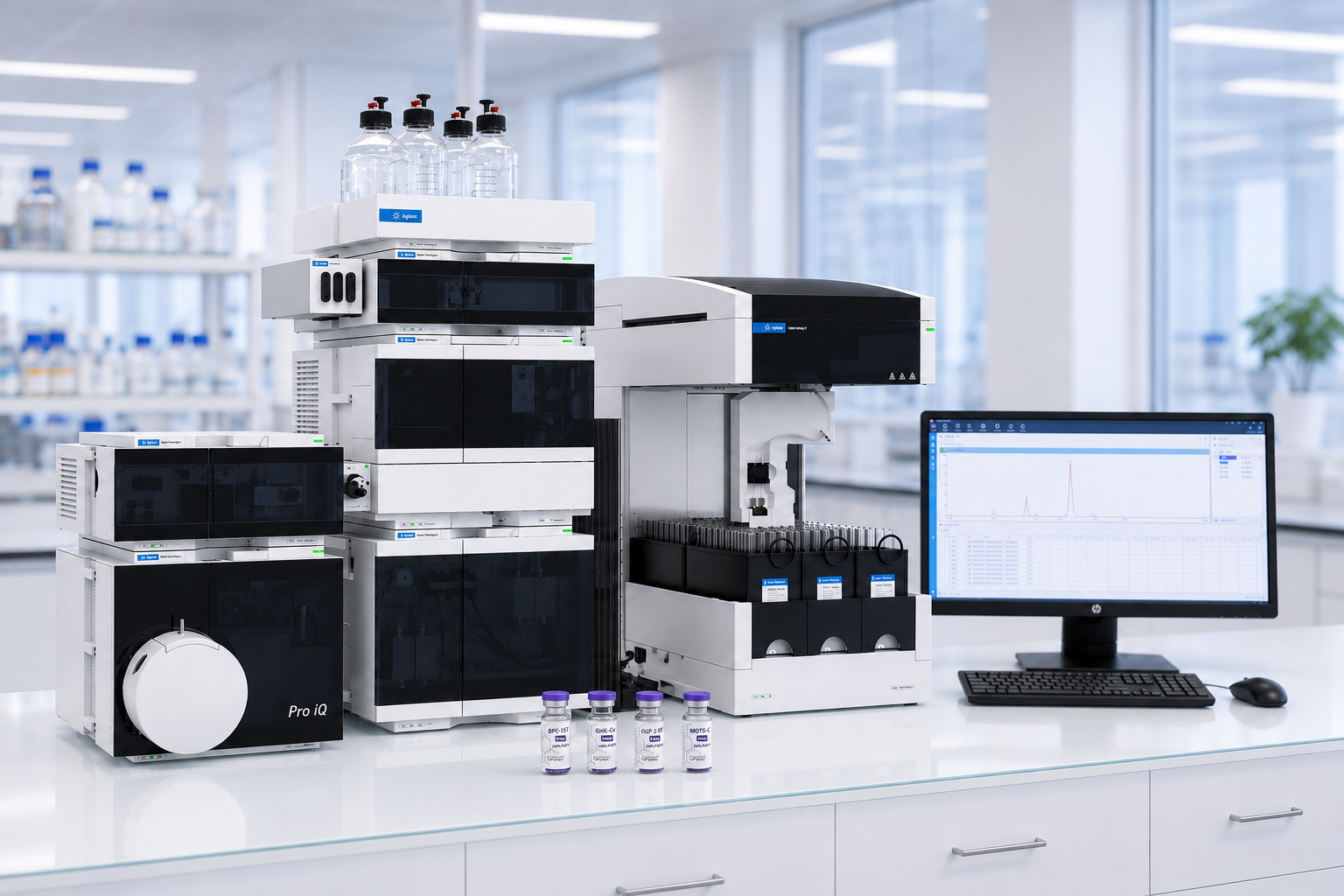
High-performance liquid chromatography (HPLC) is one of the reference methods used to assess peptide purity.
Its principle is to separate the different molecules present in a sample, allowing the target peptide to be distinguished from any impurities resulting from the synthesis process.
The result is typically presented as a chromatogram together with a purity percentage.
WHAT THIS ANALYSIS VERIFIES
- The actual proportion of the target peptide in the sample
- The possible presence of synthesis by-products
- The overall quality of the purification
WHY THIS ANALYSIS IS NOT ENOUGH
A purity of over 99% is an excellent indicator...
...but it provides no information about:
- The molecule's exact identity
- The actual peptide content in the vial
- The possible presence of endotoxins
- Heavy metal contaminants
- Microbial contamination
That is why, at GenHelix Optima, HPLC is only the first step in our quality assurance protocol.

LC-MS
Why confirm the peptide's identity ?
Two different molecules can sometimes both exhibit high purity.
Liquid chromatography–mass spectrometry (LC-MS) allows us to accurately confirm that the analyzed molecule is indeed the expected peptide.
It serves as a true molecular fingerprint.
WHAT THIS ANALYSIS VERIFIES
- The exact molecular mass
- The peptide identity
- The consistency between the declared product and the analyzed product
Why this analysis is essential
Excellent purity has value only if the peptide is actually the one stated on the vial.
At GenHelix Optima, we consider confirmation of molecular identity essential before any product is made available.

Real dosage
Why verify the actual peptide content?
A vial labeled as containing 10 mg should actually contain 10 mg.
However, HPLC purity alone cannot answer that question.
A peptide may exhibit excellent purity while still being underfilled or overfilled.
Verifying the actual peptide content ensures that the quantity present in the vial matches the amount stated on the label.
WHAT THIS ANALYSIS VERIFIES
- The actual peptide content
- Compliance with the labeled dosage
- Consistency across different batches
Why GenHelix Optima performs this analysis
Because trust begins with accurate information.
When we state a dosage, we want it to accurately reflect the actual content of every vial.

Endotoxins
Why test for endotoxins?
Endotoxins are naturally occurring components of the outer membrane of certain Gram-negative bacteria.
They can remain present in a product even after the bacteria have been destroyed.
Their presence cannot be detected by standard HPLC analysis.
WHAT THIS ANALYSIS VERIFIES
- The absence of endotoxin contamination
- The quality of the manufacturing process
- Control of the manufacturing environment
Why this analysis matters
A peptide may have a purity of over 99% while still containing endotoxins.
That is precisely why we believe quality control cannot be limited to chromatographic purity alone.
Heavy metals
Why test for heavy metals?
Heavy metals may originate from raw materials, solvents, manufacturing equipment, or the production process.
Testing for heavy metals is an essential part of a product's chemical quality assessment.
WHAT THIS ANALYSIS VERIFIES
- The absence of heavy metal contaminants
- The quality of the raw materials
- Control of the manufacturing process
Why GenHelix Optima includes it in its protocol
Because a premium peptide is defined by more than just its purity.
We also want to ensure that every batch meets the highest standards for chemical contaminants.

Sterility
Why test for sterility?
A well-controlled manufacturing environment is essential to minimize the risk of microbial contamination.
Sterility testing verifies the absence of bacteria and fungi that could compromise product quality.
WHAT THIS ANALYSIS VERIFIES
- The absence of bacterial contamination
- The absence of fungal contamination
- Control of the manufacturing process
Why this step completes our protocol
At GenHelix Optima, we believe that every analysis provides a different piece of the quality assessment.
Sterility testing complements HPLC, LC-MS, actual peptide content verification, endotoxin testing, and heavy metal analysis to provide a comprehensive assessment of the quality of every batch.
Why we go further.
In the field of research-grade peptides, purity is often highlighted as the main quality indicator.
At GenHelix Optima, we believe that a single analytical result cannot sum up all the characteristics of a product.
This is why our protocol relies on several complementary analyses.
Because a truly premium peptide is not simply a pure peptide.
It is a peptide whose identity is confirmed, whose dosage is verified, and whose absence of critical contaminants is demonstrated.
This more demanding approach allows us to offer products that meet quality criteria far superior to the standards usually observed on the market.
Each batch follows the same evaluation testing

1. Synthesis
2. HPLC Quality control
3. LC-MS Confirmation

4. Complementary analyses

5. Batch validation

6. Release for sale
Would you like to verify your analyses ?
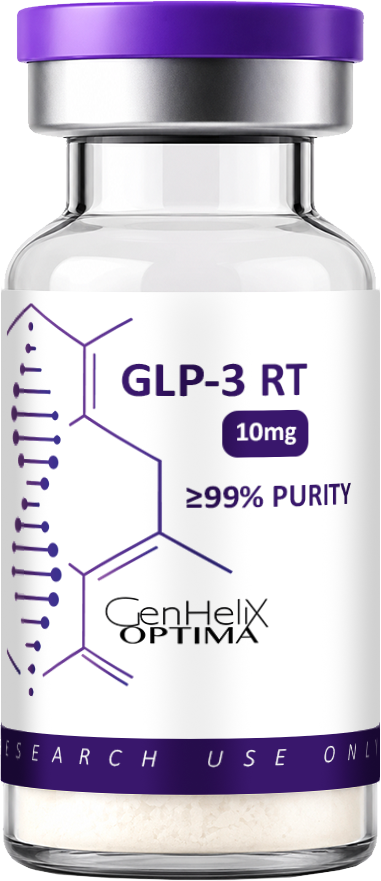
Discover how each GenHelix Optima vial is associated with an independent certificate of analysis, instantly accessible via its QR Code.