
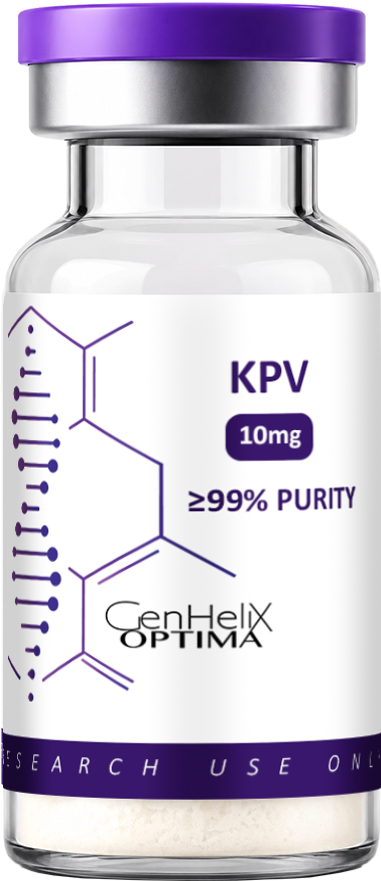
KPV
10mg CAS : 147794-53-4
74,90 €
Categories
 Immunity support
Out of stock
Diluent not included
This product is supplied in lyophilized form. Bacteriostatic water is required for reconstitution — it is not included with your order.
Bacteriostatic waterKPV is a tripeptide (Lys-Pro-Val) derived from alpha-melanocyte-stimulating hormone (alpha-MSH). It exhibits anti-inflammatory and antimicrobial properties, by modulating the production of pro-inflammatory cytokines and chemokines.
Studied mechanism of action
Unlike alpha-MSH, KPV does not act via melanocortin receptors but via the PepT1 transporter, expressed by both immune cells and intestinal epithelial cells. At nanomolar concentrations, it would inhibit the NF-κB and MAP kinase inflammatory signaling pathways, reducing the secretion of pro-inflammatory cytokines.
Research areas
Chronic inflammatory bowel diseases (IBD)
Oral administration of KPV would reduce the incidence of colitis induced by dextran sulfate sodium (DSS) and trinitrobenzene sulfonic acid (TNBS). Treated murine models exhibited markedly reduced colonic infiltration and preserved colon length.
Anti-inflammatory activity
KPV represents a research alternative to alpha-MSH, retaining its anti-inflammatory activity without inducing pigmentation. Its effects have been studied on fever, dermatitis, vasculitis, arthritis, and gastrointestinal inflammation.
Wound healing and scar formation
Research suggests that KPV may accelerate wound healing, reduce infectious risk, and limit scar formation after surgery, with a reduction in inflammatory markers and better collagen organization.
Antimicrobial properties
Studies suggest an antimicrobial and antifungal potential comparable to that of other alpha-MSH derivatives.
Scientific references
- Dalmasso et al., 2008 — mécanisme d'absorption du tripeptide via le transporteur PepT1
- Kannengiesser et al., 2008 — potentiel anti-inflammatoire sur modèles de MICI
- Brzoska et al., 2008 — revue endocrinienne complète des peptides dérivés de l'alpha-MSH
- De Souza et al., 2015 — amélioration de la cicatrisation cutanée
- Getting et al., 2003 — analyse des mécanismes anti-inflammatoires
Le certificat d'analyse de ce produit sera bientôt disponible.
| Name of product | KPV |
| Alias | 2-oxo-5-phenylpentanoic acid |
| CAS Number | 88768-11-0 |
| Sequence | Lys-Pro-Val |
| Molecular formula | C₁₁H₁₂O₃ |
| Molecular weight | 192.21 g/mol |
| PubChem CID | 13294447 |
| Purity | ≥ 99% |
| Appearence | Lyophilized powder |
| Solubility | Bacteriostatic water |
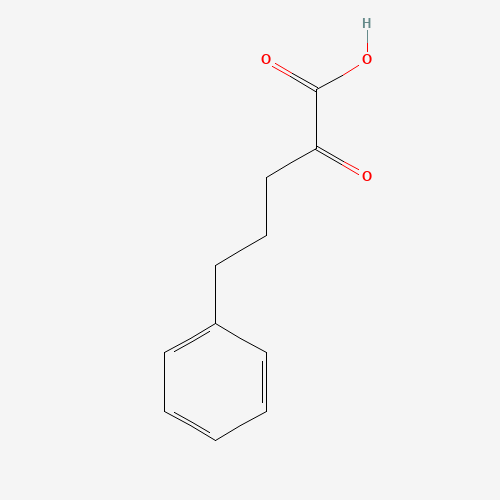
Structure moléculaire
Storage of lyophilized peptides
Upon receipt, store the lyophilized peptide at 4 °C or below, protected from light and moisture. In lyophilized form, the product remains stable at room temperature for several weeks. For long-term storage, storage at -20 °C is strongly recommended. Moisture is the main degradation factor: before opening the vial, allow it to come to room temperature to avoid any condensation inside the container.
Storage of reconstituted peptides
The shelf life of peptides in solution is limited. Freezing aliquots allows their lifespan to be extended. It is generally accepted that peptides in solution are stable for 3 weeks or more at +4 °C, and 3 to 4 months at -20 °C. Avoid repeated freeze/thaw cycles, as they can degrade the peptides.