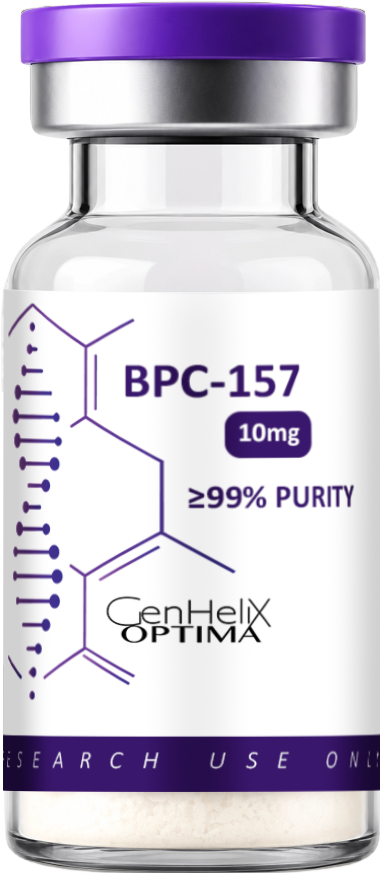
BPC-157
10mg – CAS 137525-51-0
54,90 €
Categories
 Regeneration
 Cognitive Health
In stock
Diluent not included
This product is supplied in lyophilized form. Bacteriostatic water is required for reconstitution — it is not included with your order.
Bacteriostatic waterBPC-157 is a synthetic pentadecapeptide, a fragment of the BPC (Body Protective Compound) protein originally isolated from human gastric juice. Its 15-amino-acid sequence reproduces a portion of the native BPC protein, which is considered the origin of all the properties studied in preclinical research on this compound.
Studied mechanisms of action
The scientific literature reports several pathways through which BPC-157 exerts its effects in preclinical research:
Cell proliferation
Stimulation of fibroblast proliferation and migration in culture and in vivo, in a dose- and time-dependent manner, promoting granulation tissue formation.
ERK1/2 signaling pathway
In chemical burn models, the peptide promoted re-epithelialization, dermal remodeling, and collagen deposition via activation of the ERK1/2 pathway.
Angiogenesis — VEGFR2
Stimulation of the membrane receptor VEGFR2, involved in the nitric oxide (NO) signaling pathway, promoting endothelial cell growth and collateral vessel formation.
FAK-paxillin pathway
In tendon healing studies, activation of the FAK-paxillin pathway was associated with increased fibroblast migration toward the injured site.
Research areas
Tissue healing
Acceleration of repair in various tissues: tendons, muscles, ligaments, joints, and skin.
Gastrointestinal protection
Documented cytoprotective effects on gastric ulcers, inflammatory bowel disorders, and intestinal hyperpermeability ("leaky gut").
Vascular effects
Accelerated restoration of blood supply to ischemic areas and activation of collateral vessel development in venous occlusion models.
Attenuation of drug side effects
Research suggesting reduction of catalepsy and gastric ulcers induced by neuroleptics, as well as protection against certain pharmacologically induced cardiac arrhythmias.
Antioxidant properties
Neutralization of oxidative stress markers (nitric oxide, malondialdehyde) and reduction of reactive oxygen species in the gastrointestinal tract.
Scientific references
- Huang et al., Drug Design, Development and Therapy, vol. 9, 2015 — mécanismes de cicatrisation sur brûlures alcalines (voie ERK1/2)
- Chang et al. — expression des récepteurs à l'hormone de croissance dans les fibroblastes tendineux
- Drmic et al., World Journal of Gastroenterology, vol. 24, n°48, 2018 — lésions du cæcum perforé et voie du monoxyde d'azote
- Multiples études — occlusion veineuse, colite, ischémie-reperfusion et compensation vasculaire
- Études sur la cicatrisation tendineuse — activation de la voie FAK-paxilline et migration des fibroblastes
- Škrlec et al., Applied Microbiology and Biotechnology, vol. 102, 2018 — systèmes de délivrance par Lactococcus lactis
- Strinic et al. et Jelovac et al. — arythmies cardiaques et effets secondaires liés aux neuroleptiques
- Tlak Gajger et al., Journal of Veterinary Pharmacology and Therapeutics, vol. 41, 2018 — traitement de la nosémose chez l'abeille domestique (Nosema ceranae)
| Name of product | BPC-157 |
| Alias | Body Protection Compound 157 |
| CAS Number | 137525-51-0 |
| Sequence | Gly-Glu-Pro-Pro-Pro-Gly-Lys-Pro-Ala-Asp-Asp-Ala-Gly-Leu-Val |
| Molecular formula | C₆₂H₉₈N₁₆O₂₂ |
| Molecular weight | 1418.67 g/mol |
| PubChem CID | 9941957 |
| Purity | ≥ 99% |
| Appearence | Lyophilized powder |
| Solubility | Bacteriostatic water |
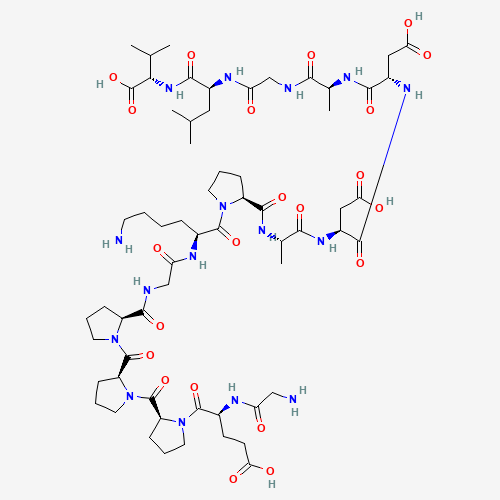
Structure moléculaire
Storage of lyophilized peptides
Upon receipt, store the lyophilized peptide at 4 °C or below, protected from light and moisture. In lyophilized form, the product remains stable at room temperature for several weeks. For long-term storage, storage at -20 °C is strongly recommended. Moisture is the main degradation factor: before opening the vial, allow it to come to room temperature to avoid any condensation inside the container.
Storage of reconstituted peptides
The shelf life of peptides in solution is limited. Freezing aliquots allows their lifespan to be extended. It is generally accepted that peptides in solution are stable for 3 weeks or more at +4 °C, and 3 to 4 months at -20 °C. Avoid repeated freeze/thaw cycles, as they can degrade the peptides.
![CJC-1295 noDAC [Mod GRF 1-29]](https://genhelixoptima.com/wp-content/uploads/2026/06/cjc-1295-nodac-vial.png)